Before the Snapshot: How the Album Shaped Family Photographs
Family photo albums turned separate prints into shared stories. Learn how sequence, captions and page design shape the way a family remembers pictures.
A family photograph changes character when it is fixed beside another one. The album made that change tangible: it gathered separate prints into a sequence that could be handled, revisited and discussed. Before the loose snapshot became the familiar unit of family photography, the album offered a way to present pictures as a shared account.
The album made order part of the photograph
A print on its own asks for attention to one moment. Set it among other prints, and its neighbours begin to affect what it seems to mean. A portrait beside a wedding picture may read as part of a family story; the same portrait beside a holiday view may suggest a different connection.
Album makers could arrange photographs by occasion, person, place or mood. The chosen order did not simply record events as they happened. It offered an interpretation: this is who belongs together, this is what deserves a place, and this is how one memory leads into the next.
That makes an album less like a box of files and more like a shelf of books. The prints matter, but so does their arrangement, and a reader can turn back to compare one page with another.
Pages turned private pictures into shared keepsakes
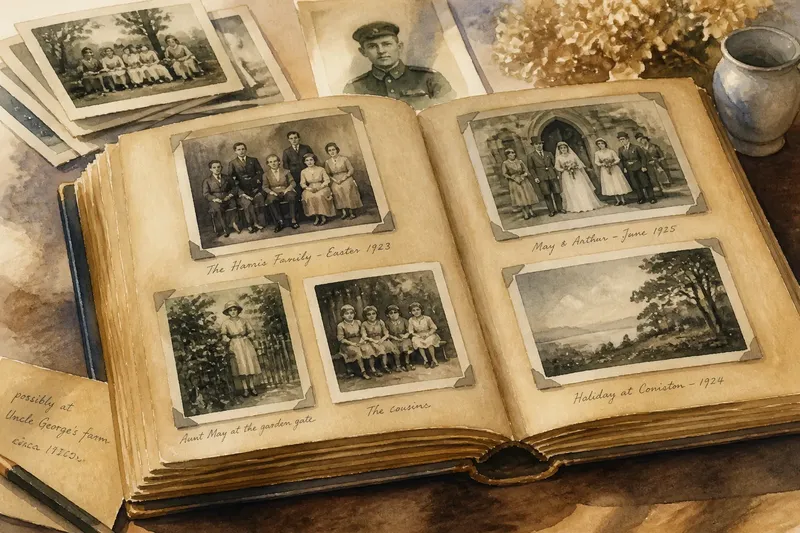
A bound album gave photographs a social setting. Someone could open it for a visitor, pass it around a table or pause over a page with a relative. The handling became part of the experience: a finger might point to a face, while a spoken name supplied context the image could not carry alone.
Albums also made selection visible. A family chose which prints to mount and which to leave out, sometimes favouring formal portraits, gatherings and milestones. The result was not a complete record of daily life but a considered presentation of what the household wished to remember together.
Material choices supported that sense of care. Heavy pages, paper mounts, corners and handwritten captions gave prints a stable place. These details were practical, but they also signalled that the images were keepsakes rather than disposable impressions.
Captions supplied names and relationships
A face can remain recognisable while its name disappears from memory. A short caption can preserve a name, a relationship or the setting: “Aunt May at the garden gate” says more than a date alone. Even a modest note helps a later viewer connect the person to the family’s language.
Captions also reveal the album’s point of view. “The cousins at the station” groups people by relationship; “A rainy afternoon” makes the setting the subject. The wording need not explain everything. A few precise words often leave room for family members to add their own recollections.
If you are arranging older prints, distinguish what you know from what you infer. A pencil note on a separate slip, or a caption that says “possibly” where identification is uncertain, preserves useful doubt instead of turning a guess into family fact.
Blank space and repetition shaped the pace
Album pages were not merely containers. A large portrait surrounded by open paper could feel important, while a row of similar images might suggest a sequence or comparison. Empty space gave the eye a pause; repeated subjects made change easier to notice.
Some albums placed a single formal portrait beside casual scenes. Others grouped several relatives or views on one spread. These choices altered the rhythm of looking, much as a pause between spoken sentences changes how a story lands.
When presenting prints now, resist filling every available space. A page with a clear focus and a little breathing room can be easier to read than a dense arrangement in which every image competes for attention.
What does an album preserve beyond the prints?
Why arrange photographs in an album?
Arrangement connects images and gives the viewer a route through them. A sequence can show relationships or recurring occasions that are hard to recognise when prints are scattered.
What makes a family album different from a photo box?
An album records choices about order, grouping and emphasis, while a box mainly stores prints together. Its pages show how someone wanted the photographs to be encountered.
Should old photographs be taken out of their mounts?
Not automatically: a mount may be part of the album’s construction or carry useful marks. If a print seems stuck, brittle or valuable, seek advice from a conservator rather than forcing it free.
How can an album help identify unknown relatives?
Look at nearby captions, repeated faces and the page’s grouping, then ask family members what they recognise. Treat a visual resemblance as a clue, not a settled identification.
A careful sequence can make a new album feel personal
Say you are assembling a small album from prints of a family gathering, but the photographs show different people arriving, eating and talking. You could place the arrival portraits first, group the shared table scenes next and finish with the quieter pictures from later in the day. A few names or brief captions would help viewers follow the gathering without turning each page into a full account.
For any album, begin by deciding what the sequence is about: a person, a place, a particular day or a changing family relationship. Then choose a restrained number of images, group those that genuinely belong together and write captions only where they add something a viewer cannot easily see. Check that the materials suit the prints and follow the maker’s guidance; for fragile or historically important albums, consult a qualified conservator.
The album’s lasting lesson is that a family photograph is not only an image of someone. Its position, neighbours and accompanying words help determine how that person is remembered. When you make or revisit an album, the order you give the prints is part of the keepsake itself.