Wide View or Tight Frame? Choosing a Lens for the Picture
Choosing a lens for the picture starts with what belongs in the frame; learn how wide and longer focal lengths shape space and organise everyday scenes.
Choosing a lens for the picture begins with a simple question: what needs to remain visible around your subject? A wide-angle lens can include a whole room or a stretch of pavement, while a longer focal length narrows attention and makes distant parts of a scene appear closer together. The useful choice is not the lens that sounds more versatile, but the view that gives the subject the right relationship to its surroundings.
Decide what the picture should include
Before changing lenses, name the thing you want someone to notice: a person, a doorway, a market stall, or the way a tree stands against a building. Then ask which surrounding details help explain it. If the cracked pavement leads towards a seated figure, it may belong; if a bright sign pulls attention away, it may not.
This distinction is more useful than simply asking whether the scene is large or small. A wide view is suited to a subject whose setting matters. A tighter view is often clearer when the setting is busy or when a particular relationship between two distant elements carries the picture.
Decide, too, whether the scene should feel open or concentrated. A wide frame can make a person feel small within a room. A longer lens can give that person more visual weight while reducing the amount of room competing for attention.
Use a wide-angle view when the surroundings matter
A wide-angle lens covers a broad angle of view. It can hold several parts of a scene at once: the table and the window beyond it, or a person and the street they are crossing. This breadth is useful when the surroundings are not decoration but part of what the photograph is saying.
Wide views also make near and far objects appear more separated. A lamppost close to the camera may look prominent while a building behind it seems comparatively distant. That shift can add depth, but it can also make foreground objects dominate if they are included without purpose.
To make a wide view easier to control, look at the edges of the frame before pressing the shutter. Check for a cut-off hand, a bright patch of sky, or a wall entering only as a thin, distracting strip. Then move yourself slightly or adjust the framing so those edge details either contribute or disappear.
Wide-angle lenses can make straight lines near the frame edges appear to lean or stretch, especially when the camera is tilted. If a building should look upright, keep the camera level and leave some breathing room around its edges. If you are photographing a person close to the lens, avoid placing their face at the extreme edge, where the perspective can feel exaggerated.
Choose a longer focal length to concentrate attention
A longer focal length takes in a narrower slice of the scene. It can help isolate a face in a crowd, pick out a detail on a distant building, or simplify a street where nearby signs and parked cars clutter a wider frame. It is not only a way to make faraway subjects larger; it changes which pieces of the scene sit together in the picture.
Because a longer lens shows a narrower view, you may need to step back to include the same subject. From farther away, the apparent distance between foreground and background often looks compressed: a row of windows may seem closer behind a person than it did in a wide view. This can make layered details feel joined rather than spread through deep space.
That effect has trade-offs. A longer lens can turn a broad, airy scene into a compact arrangement, but it may exclude a useful foreground clue or make the picture feel crowded. Check the space around your subject, not just whether the subject fills the frame.
On a phone, switching from the main camera to a telephoto camera may change the lens used; sliding a zoom control can instead crop the image, depending on the device. If you are unsure, compare the available camera options and image details rather than assuming every zoom setting behaves alike.
Make the comparison from a considered position
When the scene allows it, compare the views from the same camera position. A lens change from one spot shows how the angle of view alters what enters the frame. If you also walk closer or farther away, both the framing and the apparent relationship between near and distant objects change, making it harder to tell which choice produced the effect you prefer.
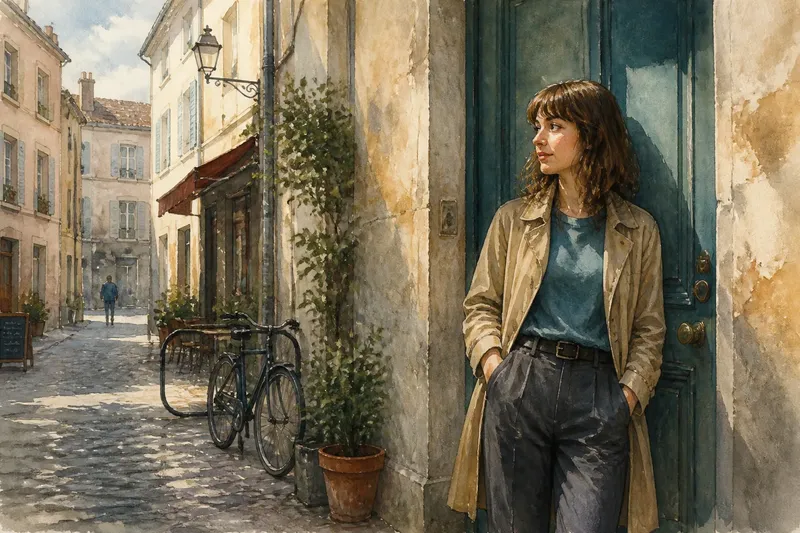
Imagine you are photographing a friend beside a painted doorway, with a bicycle rack behind them. From one place, a wide lens includes the doorway, your friend, and the rack, but the rack competes for attention. If you stay put and choose a longer lens, the tighter frame can leave out most of the rack and make the doorway sit more closely behind your friend; you can judge whether that simpler arrangement suits the picture.
If neither view works, move deliberately rather than making small, hurried adjustments. A step sideways may separate the person from a sign; moving back may let a longer lens include more of the doorway. Treat camera position and lens choice as separate decisions, like choosing a container and then arranging what goes inside it.
Choose a lens for the picture, not the label?
What does a wide-angle lens do to perspective?
Perspective depends on where the camera is, while a wide lens makes it easier to include a broad view from that position. If you move close to a subject to fill the frame, nearby parts can look much larger than distant parts, creating a strong sense of depth.
Does a longer lens always make the background blurry?
No. Background blur also depends on distance, focus, aperture, and the camera or lens in use. A longer focal length can make a background look larger and more prominent, but blur is not automatic.
Should I zoom with my feet instead?
Moving changes your viewpoint, so the relative positions of nearby and distant objects shift. A zoom or lens change from the same position changes framing without that same shift; choose between them according to whether the scene’s spatial relationships should change.
Which lens is easier for a room or a street?
A wide-angle view can include more of a small room or a busy street, but it may also collect distracting edges and exaggerate nearby objects. A longer view can simplify the scene if you have enough room to stand back and the surrounding context is less important.
Make the final frame answer the original question
Before taking the photograph, scan from the subject out to the corners. Ask whether the background supports the subject, whether near and far details feel as connected as you intend, and whether the frame includes enough context without turning every visible object into a rival.
Choosing a lens for the picture is ultimately choosing how much of the scene and its spatial character to keep. Use the widest view when the surroundings carry meaning; choose a longer view when the picture needs concentration or a compact arrangement. If you are undecided, make one careful frame of each and compare what the surroundings do, not merely how large the subject appears.